
PT Kereta Api Indonesia (KAI) – PERSERO at a Glance
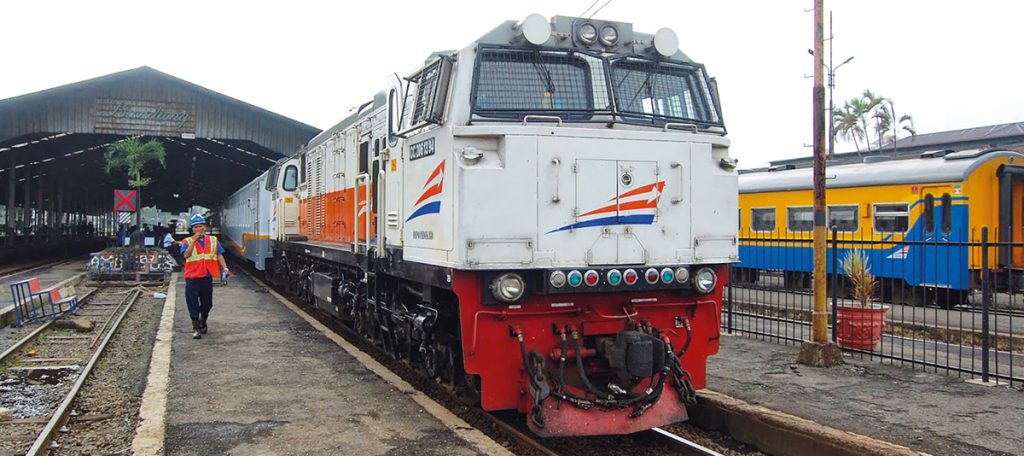
“PT Kereta Api Indonesia (Persero) merupakan Badan Usaha Milik Negara yang menyediakan, mengatur, dan mengurus jasa angkutan kereta api di Indonesia. Namun, seiring dengan dinamika dunia usaha dan berkembangnya tuntutan pasar, saat ini KAI juga menyelenggarakan kegiatan usaha penunjang lainnya dengan memanfaatkan sumber daya yang dimiliki.”
KAI was established based on Deed dated June 1, 1999 No. 2 drafted before Imas Fatimah, S.H., Sp.N.,a Notary in Jakarta, which was later amended by Deed dated September 13, 1999 No. 14. The deed of establishment was ratified by the Minister of Justice of the Republic of Indonesia through Decree dated October 01, 1999 No. C-17171 HT.01.01.TH.99 and was announced on the State Gazette dated January 14, 2000 No. 4 Appendix No. 240/2000.
The railway industry was began in 1864 when Namlooze Venootschap Nederlanche Spoorweg Indische Maatschappij commenced construction of a railway from Semarang to Surakarta, Central Java. Three other companies started to invest in building railway lines inside and outside Java ever since. The three companies that firstly involved in the railway industry were Staat Spoorwegen, Verenigde Spoorwegenbedrifj and Deli Spoorwegen Maatscappij.
After the Proclamation of Independence, Djawatan Kereta Api Repoeblik Indonesia (Railway Department of the Republic of Indonesia or DKARI) was established on September 28, 1945. Establishment date of DKARI is then commemorated as the National Train Day.
On May 25, 1963, Government of Republic of Indonesia issued Government Regulation No. 22 of 1963 to establish Perusahaan Negara Kereta Api (PNKA). Furthermore, on September 15, 1997, based on Government Regulation No. 61 of 1971, PNKA was turned into Perusahaan Jawatan Kereta Api (PJKA). With the status as a State Company and Public Service Agency, the Company formerly served public with subsidy funds from the Government.
Railway management embraced a new era when PJKA was turned into Perusahaan Umum Kereta Api (Perumka) pursuant to Government Regulation No. 57 of 1990. With the new status as a Perusahaan Umum (Perum) company, Perumka provided public services while also earned profit from the provided products and services. In terms of passenger’s services, Perumka offered three classes of service, such as: executive, business and economy classes.
On July 31, 1995, Perumka launched executive-class passenger train service with brand of Argo Bromo JS-950 Train brand that was further developed into Argo Bromo Anggrek Train (KA), which is operated since September 24, 1997. The operations of KA Argo Bromo Anggrek initiated development of other Argo brands, such as: Argo Lawu, Argo Mulia and Argo Parahyangan.
To encourage Perumka towards a service company, on February 3, 1998, the Government issued Government Regulation No. 19, 1998 concerning Transformation of Perusahaan Umum (Perum) Kereta Api into a Perusahaan Perseroan (Limited Company). Therefore, the name was altered into Perusahaan Perseroan (Persero) PT Kereta Api, or known as PT Kereta Api (Persero) or PT KA. With the new status, the Company is operated as a profit-oriented business entity. To keep exercising part of the mission as a public service organization, the Government provided Public Service Obligation (PSO) funds.
Based on Approval of the Minister of Law and Human Rights No. RI. AHU-AH.01-16788 dated October 5, 2009, Board of Directors of PT Kereta Api (Persero) issued Instruction of Board of Directors No. 16/OT.203/KA-2010 concerning the change of name of PT Kereta Api (Persero) to PT Kereta Api Indonesia (Persero) or KAI, effective since May 11, 2010.
Along with the dynamics of the business sector and the growing market demands, KAI is currently also operating other supporting business activities by utilizing its resources. The business lines include property management related to railway services, railway-based tourism, restaurant (on train services and at the stations), including catering and logistics distribution services.
In November 2017, KAI has entered a new stage to seek financing alternative for its business expansion by issuing bonds for the KAI establishment in 1946. The issuance of Kereta Api Indonesia Bonds I of 2017 received a great response from the public and investors. This success has motivated KAI to work harder to fulfill public expectations on the Company’s service excellence and performance.
In its journey, KAI has been proven as a key factor of the country’s growth with its role as backbone of the railway transportation system that has transported 394.1 million passengers and 40.1 million tons of cargo in 2017.
On August 1, 2018, KAI successfully operated the first light rail transit (LRT) system in Indonesia that started commercial operations in Palembang, South Sumatera. The LRT South Sumatera has the track length of 23.4 km, passing total 13 stations. KAI continues to develop and improve quality of its facilities, infrastructure and services to improve connectivity of Indonesian people and to deliver more efficient national logistics system by providing efficient, low emission, safety and comfortable railway transportation. Operating railway and supporting businesses through best business practices and organizational model to provide high added-value for the stakeholders and environment conservation based on four main pillars: Safety, Punctuality, Service, and Convenience.
Vision
To become the best railway service providers focusing on customer service and fulfilling stakeholders expectation.
Mission
Operating railway and supporting businesses through best business practices and organizational model to provide high added-value for the stakeholders and environment conservation based on four main pillars: Safety, Punctuality, Service, and Convenience.
Corporate Culture
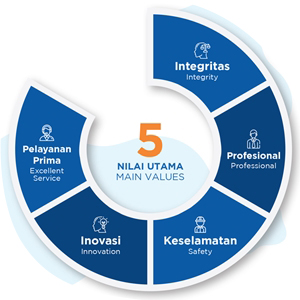
INTEGRITY: Act consistently in accordance with the values of organizational policies and code of conduct of the Company. Have the understanding and desire to adjust to such policies and ethics and act consistently even though it is difficult to do so.
PROFESSIONAL: Have the ability and mastery in the field of knowledge related to work, able to master how to use, develop, and share knowledge related to work to others
SAFETY: Has an uncompromising nature and consistent in carrying out or creating systems or work processes that have the potential for low risk of accidents and safeguarding the company’s assets from possible losses.
INNOVATION: Always develop new ideas, carry out continuous corrective actions, and create a conducive environment for creation so as to provide added value to stakeholders.
EXCELLENT SERVICE: Provide the best service in accordance with satisfying quality standards and meet expectations or exceed customer expectations by fulfilling 6 A main elements: Ability, Attitude, Appearance, Attention, Action, and Accountability.
Infrastructure
Railways on Java
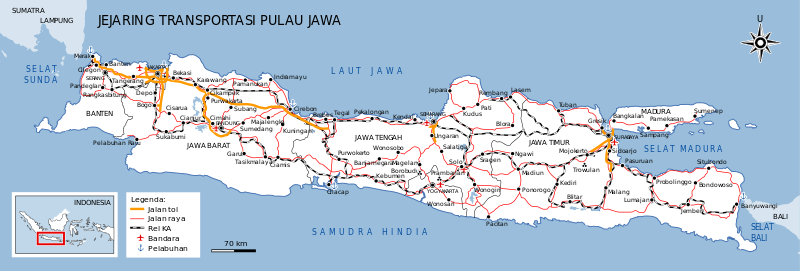
The first railways in Indonesia were built on the island of Java, using 1,435 mm (4 ft 8 1⁄2 in) gauge. During the Japanese occupation, they were converted to 1,067 mm (3 ft 6 in) gauge. At its greatest extent, the Javanese network had a length of 4,807 kilometers (2,987 mi), connecting most parts of the island. The Javanese network train (in Java Island) is divided into nine operating divisions (Train operation area or DAOP).
Railways on Sumatra
Medan railway station, serving intercity trains as well as Railink airport train service to Kuala Namu Airport
In Sumatra as of 2013, there are 1,869 kilometers of track, of which 1,348 km are operational. Several unconnected railway networks were built in the time of the Dutch East Indies:
- Banda Aceh-Lhokseumawe-Besitang-Medan-Tebingtinggi-Pematang Siantar-Rantau Prapat in northern Sumatra (the Banda Aceh-Besitang section was closed in 1971, but is being rebuilt, as of 2011)
- Padang-Solok-Bukit tinggi in West Sumatra
- Bandar Lampung-Palembang-Lahat-Lubuk Linggau in southern Sumatra.
Plans to connect up and fix these isolated lines are included in the Trans-Sumatra Railway plan. Railway services in Sumatra by operational is divided into three regional divisions, which are:
Railways on Kalimantan
In 2010, plans were announced for Kalimantan to get a 122 km long 1,435 mm (4 ft 8 1⁄2 in) standard gauge railway for the transport of coal between the Muara Wahau [id] mine and the port of Bengalon. In January 2016, Russian Railways reported that its construction of a railway in Kalimantan will finish in 2019.
Railways on Bali
In 2019 it was reported in Gapura Bali that Wayan Koster, governor of Bali, “is keen to improve Bali’s transportation infrastructure and is considering plans to build an electric rail network across the island”.
Railways on Sulawesi
The Trans-Sulawesi Railway is under construction, and will be built with 1,435 mm (4 ft 8 1⁄2 in) standard gauge which is wider than the 1,067 mm (3 ft 6 in) cape gauge used in Java and Sumatra to accommodate more weight and speed.
Railways in Papua
A 440km railway from Manokwari to Sorong in Papua is planned.
Passanger Services
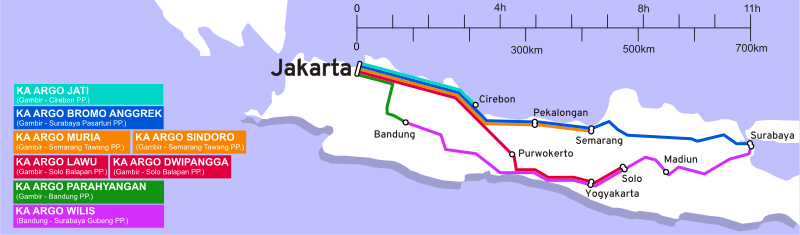
Other than in West Sumatra, where only weekly tourist trains operate, PT Kereta Api Indonesia (Persero) provides extensive passenger services. Various classes are available, from “‘Argo’” class with reclining seats and plane – like facilities, executive class with air conditioner and reclining seat comparable to the better classes of other countries’ railways, business coaches which recently have been equipped with air conditioner and reclining seats much like executive class, to the hard bench, but still air conditioned economy class coaches for cheaper trains. In last couple of years, the business and economic class are in the process of being equipped with air conditioned system. The whole process was completed in early 2013.
Sleeper trains have existed in Indonesia. The last all-sleeper train service was Bima express train which ran from 1967 to 1984 when it was changed to mostly coach, leaving only one or two sleeping cars. It ran in this configuration until 1995, when the sleeper cars were withdrawn and modified into seating coach. Since 2018, sleeper trains have been re-activated for the Argo Bromo Anggrek service from Jakarta to Surabaya.
Argo Bromo Anggrek Executive coach
In Java, most trains connect Jakarta and the hinterland – regional (or “cross-country” services) have not been fully developed. Between pairs of important cities such as Jakarta and Bandung, intensive hourly services are provided.
Most passenger trains in Indonesia, except commuter locals, are named. The names varies from plainly descriptive such as Depok Ekspress (a fast service between Jakarta and Depok), through Logawa (name of a river near Purwokerto, which is served by the train), Argo Lawu (Mt. Lawu, an extinct volcano near Solo, which is served by the said express train), to more or less meaningless, though romantic, names such as Bangunkarta (abbreviation of names of cities it serves: Jombang-Madiun-Jakarta) and Matarmaja (Malang-Blitar-Madiun-Jakarta).
Gumarang Business coach
Railway passenger services experienced a renaissance in the 1995-1999 period, with the introduction of many new passenger express services. With the advent of cheap airplane tickets, PT Kereta Api has experienced a downturn in the number of passengers carried, though the number has stabilized and most trains remain at more than 50% occupancy rate.
Women only carriages
As a response to many reports of sexual harassment in public places, including commuter trains and buses, PT Kereta Api launched women-only carriages in some commuter trains in Jakarta metropolitan area in August 2010. On May 13, 2013 PT KAI changed women-only trains to regular trains which at the front and back of the train has a coach for women only. This rule apply in KRL Jabodetabek.
Priority seat
PT KAI designates priority seats to elderly passengers, pregnant women, disabled passengers and mother with infant to ride public transport with an equal degree of access and comfort as other people. This apply in KRL Jabodetabek. Priority seat not only in the first and end of the train like in women only carriages, but eight seats in each carriage are designated as priority seats.
Priority Class (Sleeper Train)
PT KAI relaunched the Sleeper Train service in June 11, 2018. This sleeper train is equipped with excellent facilities even in the same class as a first class aircraft cabin. The first route for Sleeper Train is from Gambir Jakarta to Surabaya. The operational of the Luxury Sleeper Train will be taken over by PT KA Tourism.
Freight services
The railway system in Java is more or less a passenger-oriented system, and there are few freight services, due to the limited capacity of the tracks. Some notable freight service in Java include the Kalimas container train and the Parcel train between Jakarta and Surabaya, petroleum trains between refineries or oil pipe terminals and oil depots, and quartz sand trains in Central Java.
But in recent years, there has been many efforts to increase freight traffic in Java by introducing the GE CC206 locomotives, as well as building double track lines that connect Jakarta and Surabaya on North Coast line to increase the number of container trains between both cities. Many container ports have also been built on intermediate cities and towns. This effort already attract some customers who normally shipped their products via roads.
The system in South Sumatra is rather freight-oriented. Coal unit trains, carrying coal for an electricity plant are given priority over passenger trains. In West Sumatra, the remaining railway line serves the cement plant at Indarung, near Padang, and in North Sumatra, several oil palm and rubber plantations are served by freight trains.
Urban rail and rail-based rapid transit – Greater Jakarta
A Commuter Line electric train takes curve on the elevated railway near Mangga Dua, Central Jakarta.
KRL Commuterline Jabodetabek is one of operational urban rail network in Indonesia, serving commuter routes in Greater Jakarta which comprises cities of DKI Jakarta, Depok, Bogor, Bekasi, Tangerang, and South Tangerang as well as regencies of Bogor, Bekasi, and Lebak. The other operational urban rail network are Jakarta MRT, Jakarta LRT, and an airport rail link to support the public transport network in the area.
Greater Surabaya
Regional rail functions as commuter rail in Surabaya, so technically there is no urban rail network. However, there are plans for a mass rapid transit network in and around Surabaya. A 32 km diesel line from Mojokerto to Sidoarjo has been put into service, with 6 daily return trips.
Palembang
Palembang Light Rail Transit had operate in June 2018, before the 2018 Asian Games.
Medan
Medan has Kualanamu Airport Rail Link transport which linking Kualanamu International Airport to Medan station and vice versa.
High-speed Rails
In recent decades, Javan transportation backbones — north coast road and railway system that serves Jakarta-Surabaya corridor, has suffered greatly from both freight and passenger congestion. The plan to build a high-speed railway system in Java has been around for many years. However, it was not until 2008 that the idea had been contemplated seriously. It was Japan International Cooperation Agency’s proposal that initiated the idea to build high-speed rail for the Indonesian island of Java, linking up the densely populated corridor from the capital Jakarta to Surabaya city (covering 730 km) in East Java.Japan is eager to export their Shinkansen high-speed rail technology abroad. Following up JICA’s initial study in 2012, the detailed feasibility study was concluded in 2014. In recent years, Indonesia has been undergoing a revival in railway expansion and upgrades. The high-speed rail corridors have been proposed but not implemented yet, since it was deemed too costly.
In April 2015, China had entered the race with a counter-offer to build the Jakarta-Bandung high-speed rail in Indonesia. A bid which alarmed Japan that has been nurtured the idea for years.
In July 2015, the Indonesian government announced their plan to build the high-speed rail system connecting Jakarta and Bandung, and devised a competition between Japan and China train-makers as potential bidders. Japan and China had expressed their interest in the project; both countries have done comprehensive studies of the project.
In late September 2015, Indonesia awards this multibillion-dollar railway project to China over Japan.
The proposed high-speed rail will connect the nation’s capital Jakarta with Bandung city in neighboring West Java province, covering a distance of 150 kilometers, and is also expected to expand further, connecting to Indonesia’s second largest city, Surabaya in East Java. The project is scheduled to commence in late 2015, and is expected to open its operations to public by 2019.
In December 2015 discussion for the Jakarta-Surabaya high-speed rail was commenced by the Indonesian Coordinating Minister of Maritime and Resources. Academicians from two major universities in Indonesia, and employees from Japan International Cooperation Agency, were invited to attend the discussion.
KAI – Development Projects
KAI initially only conducted business on the railway services, but along with the dynamics of the business world and the growing demands of the market, KAI is currently also carrying out other supporting business activities by utilizing its resources. That includes, property management services related to train rail, railway-based tourism, on train services and at the station, including catering services and logistics distribution.
At this moment, KAI operational coverage includes the island of Jawa and Sumatra. The working area on the island of Jawa is divided by the Operational Area (Daop), while the working area in Sumatra is divided by the Regional Division (Divre), which consists of: 9 Operational Areas (Daop) and 4 Regional Divisions (Divre). KAI is currently operating 583 stations and 4,675 km of rail network throughout Jawa and Sumatera for 1117 train trips daily. Also, KAI has a total of 320 million square meter of land, 16,424 company-owned houses and 3,672 company-owned buildings scattered in Jawa and Sumatera which has potential to be commercialised for non-transportation businesses.
In conducting its business, KAI continues to apply the best standards in its field based on applicable management system and organisation model. KAI has employed international standard of management systems to run the business namely ISO 9001:2008, ISO 31000:2009 and ISO 27001:2013. Also, KAI continues to improve and co-evolve with the development of the business. Advancement of Information Technology (IT) is one of the latest positive aspects absorbed by KAI. Development in information technology pushes KAI to implement business strategies by placing IT as a key element in the innovation process conducted by the Company. In 2015, to further improve customer service in terms of the ease of getting train tickets, a new ticket purchasing service facility in the form of Train tickets vending machine purchase (electronic kiosk/e-kiosk) was launched. It will enable passengers to buy ticket without having to queue at the counter as to improve the efficiency and cost-effectiveness as well as create new business value for the Company. Besides, KAI has used some of the technology services from SAP to support the Company’s performance e.g. SAP Fico to improve the administration and financial reporting, SAP MM/PM to make efficient use of inventory and maintenance and SAP payroll for workers payroll. Accurate information system is expected to improve operational efficiency, simplify and accelerate the monitoring of risk management activities.
In terms of organization model, KAI had made several rapid changes during transformation period, ever since 2009, to address the market demands and to adhere to Good Corporate Governance requirements.
KAI Access – Online Ticketing System
Online Ticketing (Web)
Online Ticketing (Mobile)