

Introduction to State Railways of Thailand
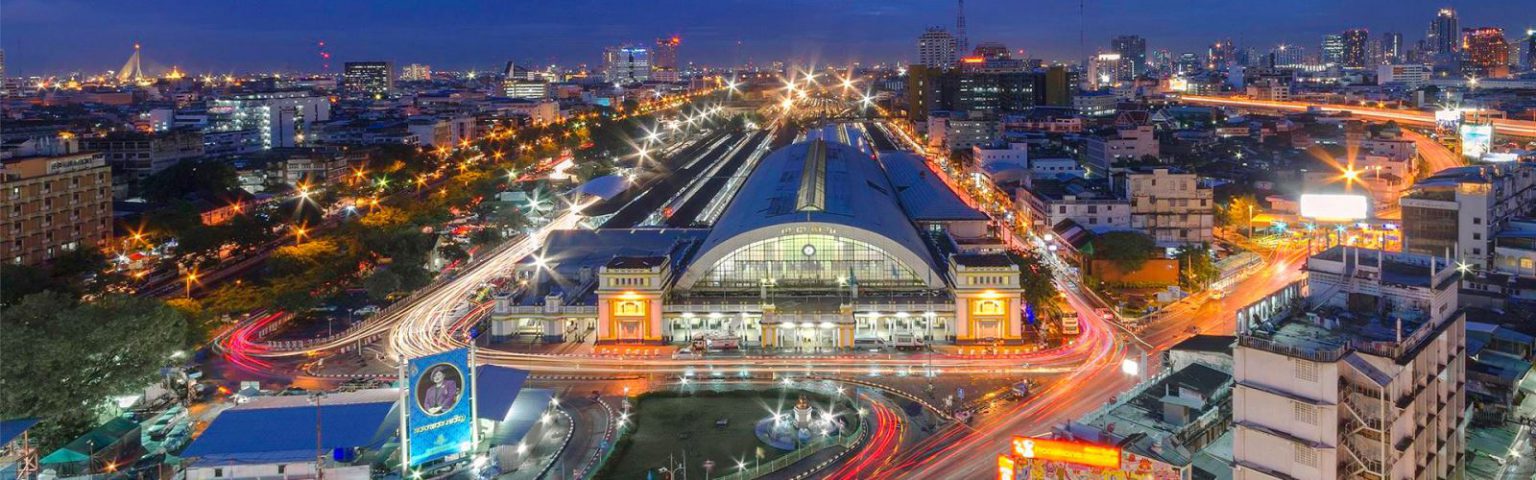
“To be the best state rail operator in ASEAN in 2027”
The State Railway of Thailand was founded as the Royal State Railways of Siam (RSR) in 1890. King Chulalongkorn ordered the Department of Railways to be set up under the Department of Public Works and Town and Country Planning. Bangkok – Ayutthaya, the first line was inaugurated on 26 March 1896. The Southern Line, Bangkok Noi (Thonburi) – Phetchaburi was first operated on 19 June 1903.
Unlike the Southern Line, the Northern, Northeastern, and Eastern Lines had been originally built to European standard gauge (1,435 mm.) before they were entirely changed to Meter Gauge(1,000 mm.) in September 1919, taking 10 years for regauging of all lines. On 1 July 1951, RSR changed its name to the present State Railway of Thailand (SRT).
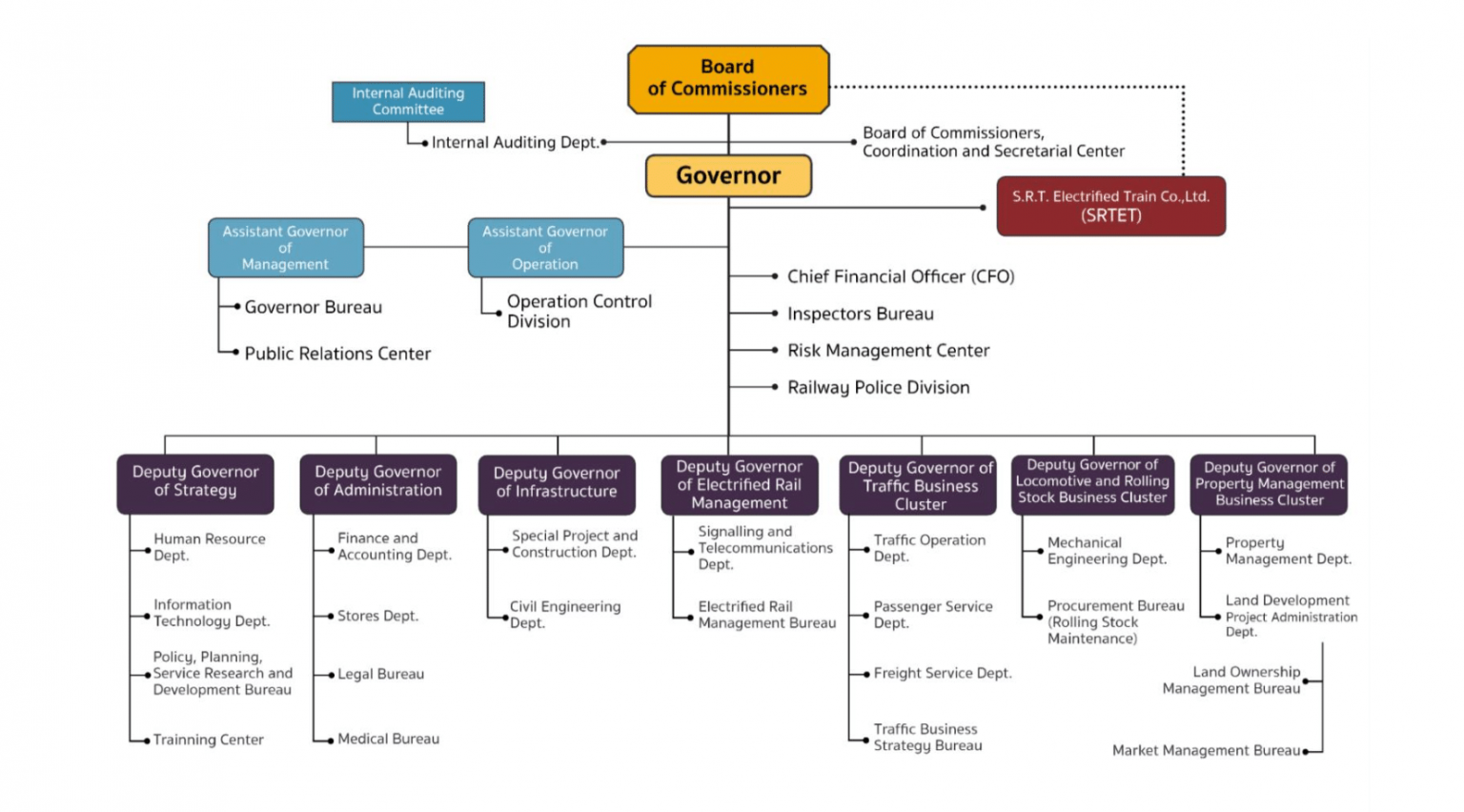
Due to global challenges, the State Railway of Thailand has to develop human resources to support the mass transit and freight transport. The restructured organization is presently issued.
Objectives of the Railway Enterprise Plan 2017-2021
- To enhance the quality of modern rail transport service and good management to promote national competitiveness under changing environment.
- To improve the performance of the Railway Both primary and secondary businesses Including effective cost management.
- To achieve the development of organizations and personnel in line with the rail infrastructure investment plan. This will lead to the long-term competitiveness of the Railway.
- To achieve the integration of cooperation among various departments of the Railway in pushing the railway vision. Efficiency and effectiveness.
- To develop the organization to be integrated and connected To make the operation more efficient.
Organization Chart
Strategies
The success of a strategic plan is measured by indicators of the strategic level of core business and non-core business, which is measured by the production process and service process. Strategic indicators have goals that make EBIDA positive. The committee that drives the plan will have the duty to monitor and improve. Problems and obstacles for the operation In addition, the Committee should have the power to incur the sanctions tied to the gainsharing principles and allocate the rewards based on the weight, proportion, responsibility of each group or individual. Deputy Governor, the monitoring and improvement of the plan The strategy can be carried out in multiple cycles until the goals of the strategic plan are achieved: increase revenues, reduce positive EBIDA expenses and increase the proportion of rail transport volumes.
Strategy 1
- To increase the capacity of rail transportation service.
- Develop a railway network to connect between regions.
- Increase the number of locomotives and casters in accordance with the business plan.
- Development of signaling system.
- Maintenance optimization of infrastructure to meet the standard.
- Building Confidence in Safety.
Strategy 2
- Increasing income and reducing expenses.
- Increase management efficiency in the core business.
- Developing the area around the big station.
- Study and develop new business.
- Cost reduction.
Strategy 3
- Mobility and improving performance.
- Have a connected information technology system and support decisions to promote performance.
- Organization management and development.
- Human Resource Management and Development
Passenger Operation
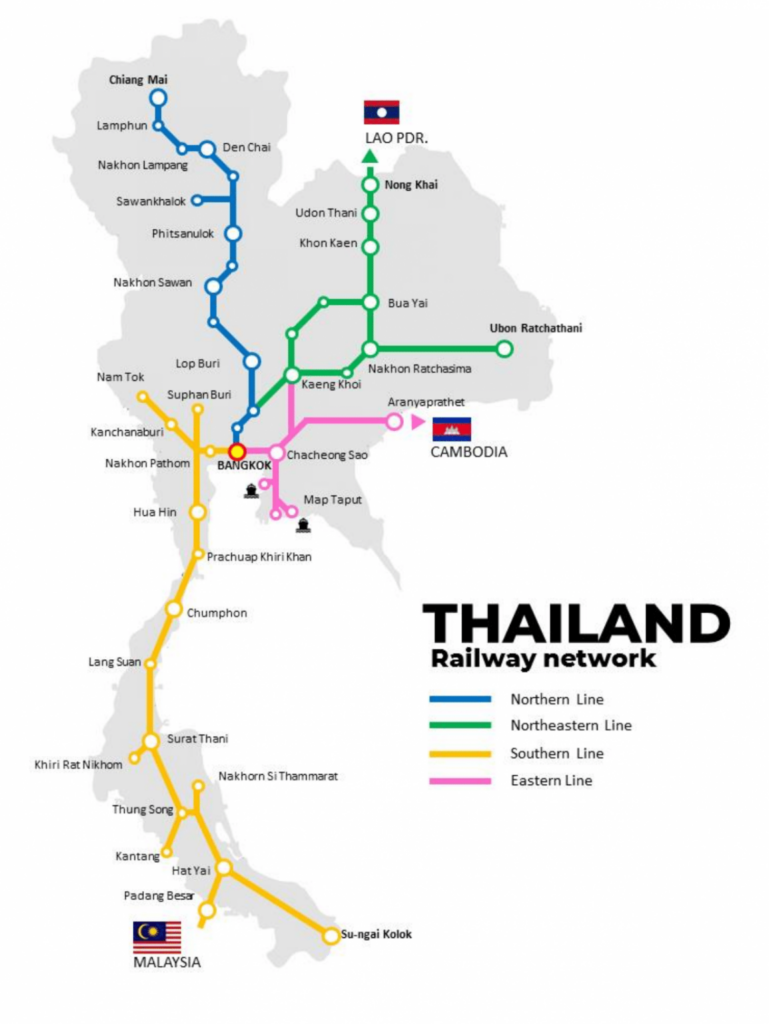
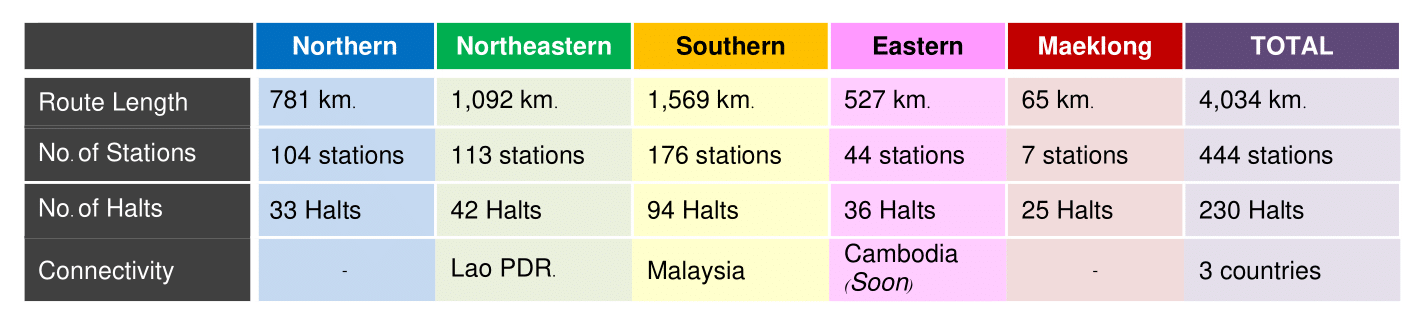
Presently, SRT operates four main lines radiating from Bangkok: the Northern Line that terminates at Chiang Mai; the Northeastern Line with two main lines running to Nong Khai and to Ubon Ratchathani; the East Line to Aranyaprathet connecting to Cambodian border; the Southern Line to Padang Besar, interchanging to Malaysian Railway; and Su-ngai Kolok, close to the Malaysian border.
Fiscal
In fiscal year 2018, the performance of SRT carried 36.8 million passengers increasing 1.8% from fiscal year 2017. SRT provides the Special Train 997/998 from Bangkok – Ban Plu Taluang – Bangkok on Saturday and Sunday since 17 March 2018 to support tourism in Pattaya, Sattahip and Chonburi which the one of most popular destination to the east coast of Thailand.
Additionally, SRT has planned to purchase the 184 DMU and 273 passenger cars for commercial long distance train service and the 216 DMU for public service obligation (PSO).
Rail Network
Status of SRT Trains
SRT provides 263 trains per day which include 152 PSO trains and 84 commercial trains as below:
First class (1st class)
- Air-conditioned sleeper coach with 2 berths in a private room
Second class (2nd class)
- Type 1: Sleeper coach – Each coach, there are 32 – 40 berths in both air-conditioned and non-air-conditioned type.
- Type 2: Reclining seat – Each coach, there are 30 – 76 reclining seats in both air -conditioned and non-air-conditioned type.
Third class (3rd class)
- There are 74-76 seats in each non-air-conditioned coach.
Freight Operation
In fiscal year 2017, SRT transported 11.91 million tons of freight, generating approximately 1.74 million baht in revenue, which represented an increase amount 2.39% and increase revenue of 6% from previous fiscal year. The 12 CSR Ziyang Locomotives of TPIPL Company for cement haulage increased 34.02%.
SRT has planned to implement five projects of freight in 2018:
- Business partnership for products export
- Freight stations facilities development with private sector
- Increasing the domestic container train
- Increasing the container train in ICD Lad Krabang – Laem Chabang Port
- Logistic service system development with domestic partnership. In addition, including 100 Locomotives (Passenger & Freight) and 800 – 1,000 BCFs after the completion of double tracking project.
Service Planning
According to the infrastructure projects in various fields, SRT plans to service and operate when the said projects are mostly completed to increase the performance by making the rail transportation more convenient and meeting customers’ needs. Presently, SRT plans to procure the new locomotives, passenger train sets, DMUs and freight cars are as follows:-
- 50 Diesel-Electric Locomotives
- 20 Shunting Locomotives (for Red Line and Bangsue Grand Station)
- 50 Electric Locomotive for launching electrified train
- 216 DMUs for PSO services
- 184 DMUs for long distance services
- 273 Passenger cars for replace and new long distance train services
- 208 Passenger cars for replacement
- Passenger Trains and DMUs for new line (Chiang Khong and Nakhon Panom)
SRT prepares to reorganize the commuter train and ordinary train service when Bangsue Grand Station open, the commuter and ordinary train will relocate origin/destination station from Bangkok to Rangsit (north and northeastern line PSO trains) and Taling Chan (southern line PSO trains).
Moreover, SRT prepares to improve ticketing service. The Ticket and Reservation System Stage 2 (STAR-2) is presently used until 2020. SRT will reveal and launch a new ticketing and reservation system called D-Ticket in 2020.
When SRT ascertains customers’ needs, the new performance of D-Ticket will give passengers more convenient. Passengers can book a seat via every railway station, mobile application and website. They can also check their reservation by QR code. About present payments, passengers can pay by cash, credit card and debit card. In the future, SRT will provide a variety of payment methods such as Counter Service at convenience stores, post offices, banks and digital payment.
Double Track Project
Railway infrastructure is mostly single track that leads to rail traffic congestion. Overburdened tracks in some areas of network obviously cause congestion, delays and accidents. To solve these problems, increasing potential network, developing transportation and logistics system including relevant development plans are needed. The Thai government promotes railway system as an effective solution.
In this regard, the 2015 – 2022 Thai Transport Infrastructure Development Strategy has been formulated which track doubling projects are included.
New Main Line
Despite the fact that SRT came up with many railway lines project many years ago, the construction has not been activated yet. At the present, the Double Track Projects are high priority.
The railway network will increase from 47 to 61 provinces after completion of these projects. Currently, SRT is preparing to budget for a feasibility study (F/S).
Bangkok Red Line Project
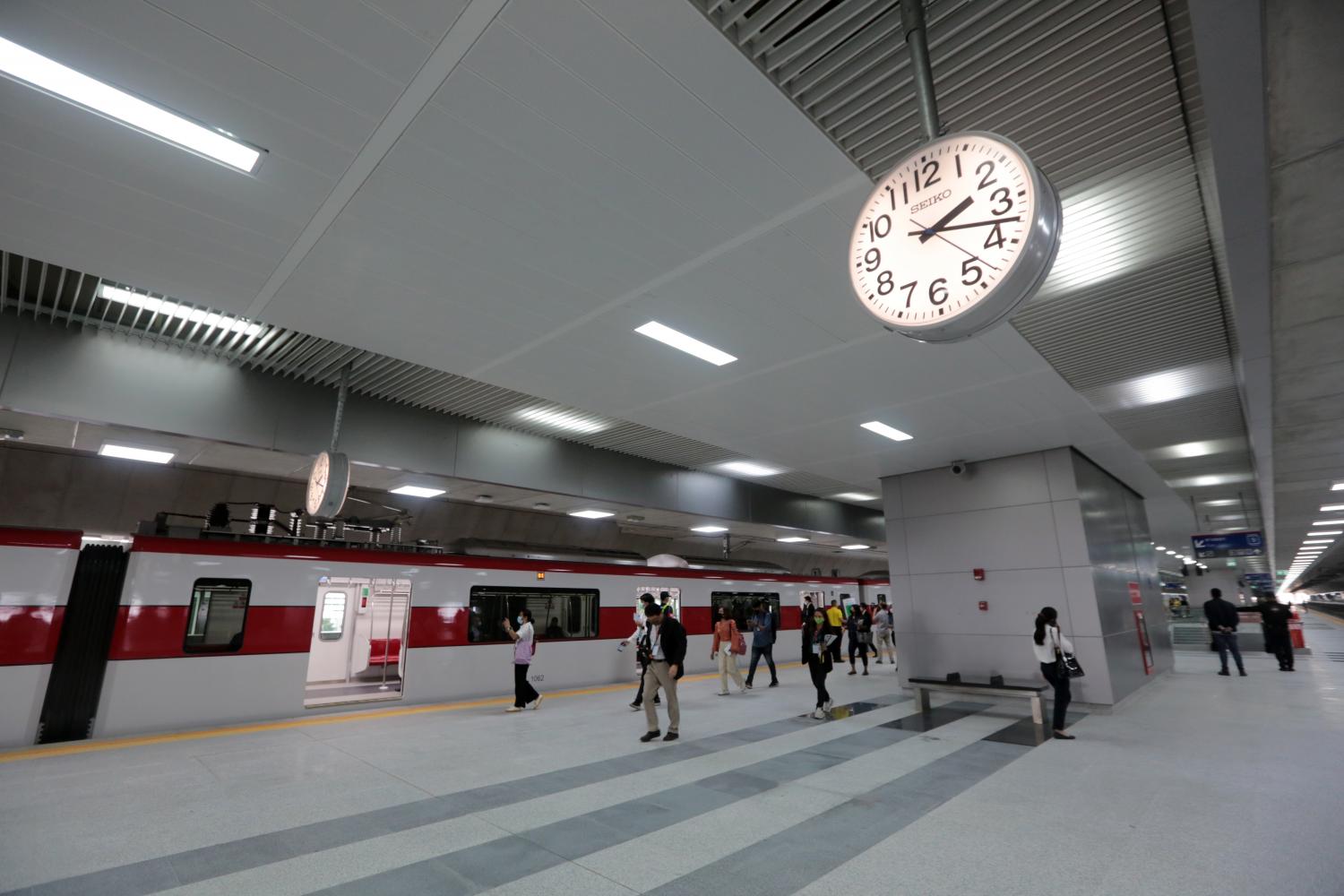
The construction of the first phase of Red Line, mostly elevated suburban railway, covers the route from Bang Sue – Taling Chan (15.26 km) in the Western Section, and the Northern Section, Bang Sue – Rangsit (26.30 km), and is funded by an Official Development Assistance Loan from the Japan International Cooperation Agency (JICA).
The civil work on the northern line commenced in March 2016, while the electrical and mechanical work has begun in June 2016. It is expected to complete in June 2020. When this project completed, the main station will be transfer from Bangkok Station to Bangsue Grand Station, the biggest central station in Southeast Asia. There are 4 floors;
- Basement – Car parking and connecting to MRT Blue Line
- Ground floor – Ticket offices, convenience shops, offices and waiting area
- Second floor – 12 platforms of metre gauge train services (Red Line Commuter and Long Distance Train)
- Third floor – 12 platforms of High-Speed Train services
High-Speed Train Project
High-Speed Train Project: Bangkok – Nakhon Ratchasima – Nong Khai
A Memorandum of Understanding (MOU) on the cooperation of the development of rail infrastructure was signed between the government of the Kingdom of Thailand and the government of the People’s Republic of China on 19 December 2014. Thai Prime Minister, General Prayut Chan-o-cha and Chinese Premier, Li Keqiang had a bilateral discussion in the first Lancang – Mekong Cooperation Leaders’ Meeting on 23 March 2016. It is noted that the project would continue as a G2G basis and Thailand would become the sole rail project investor, starting from Bangkok – Nakhon Ratchasima and following further phases.
Project Cost : 240,000 million Baht
Project Description :
The Study and Design of High Speed Rail System, Bangkok – Nong Khai, Phase 2: Nakhon Ratchasima – Nong Khai, a total length of about 355 km, finally extended the scope of the study and design to cover the study and design of a standard gauge (1.435 meter) double track to accommodate the high speed rail system in the future. The study could be summarized in 2 cases as follows:
- Case 1: Mixed Traffic denoted the study and design to accommodate a conventional train at the maximum speed of 200 km/h and a freight train at the maximum speed of 120 km/h.
- Case 2: HSR only denoted the study and design to accommodate a high speed train at the maximum speed of 300 km/h without a freight train.
There would be 5 elevated stations namely Bua Yai, Ban Phai, Khon Kaen, Udon Thani and Nong Khai.
Project description
- Bangkok – Nakhon Ratchasima section in phase 1 (252.3 km)
- 1.435 standard-gauge rail, with a speed of 250 km/hr.
- 3 structures: at-grade track, elevated track and tunnels
- 6 stations: Bangsue, Don Mueang, Ayutthaya, Saraburi, Pak Chong and Nakhon Ratchasima
- Operation Control Center (OCC) and EMUs Maintenance Depot located in Chiang Rak Noi
- Chinese HSR Design Standard and Technology
- Specification of cars and systems are under negotiation.
- Construction started in March 2018 and will be complete in 2023.
High-Speed Rail Linked 1 Airport Project: Don Mueang – Suvarnabhumi – U-Tapao
High-Speed Train Project: Bangkok – Phitsanulok – Chiangmai
The cooperation between the Ministry of Transport of Thailand and Japan’s Ministry of Land, Infrastructure, Transport and Tourism of Japan (MLIT).
- Cooperation for the development of HSR on the route between Bangkok – Chiang Mai
- 1.435 standard-gauge rail, with a speed of 300 km/hr.
- 3 structures: at-grade track, elevated track and tunnels
- 7 stations: Bangsue, Don Mueang, Ayutthaya, Lopburi, Nakhon Sawan, Pichit and Phitsanulok in the first phase
- Executive committee at ministerial level
- Working groups
SRT Online Ticketing System

Online Ticketing (Web)

Online Ticketing (Mobile)