
An Overview of Vietnam Railways

“Only by innovating with the highest decisive on all aspects, from mind to actions, our company will be able to survive and develop.”
The first railway line of Vietnam was constructed in 1881 with 71 km in length linking Sai Gon and My Tho. Then the Trans-Viet line was operated in 1936. Up to now, railway network has been made a rapid leap compared with the starting period in terms of its scale and operation capacity. Vietnam Railway network consists of 7 main lines linking and passing through 35 provinces and cities with difficult terrains.
With more than 130 years of operation, VNR has been continuously developing, now becoming a one-member limited liability company owned by the State, operating and maintaining the entire infrastructure of the national railway network.
Main Business Sector
-
To trade in railway transportation, domestic and international multimodal transport.
-
Management, exploitation, maintenance and repair of the national railway infrastructure system.
-
Trading in railway infrastructure system.
-
Operate national railway transportation.
-
Agent and transport services for railway, road, waterways, airways.
-
Consulting, surveying, designing, manufacturing, building and repairing vehicles, equipment, spare parts specialized in railway and mechanical products.
Industry & Profession Related
-
Business tourism, hotels, import and export of goods.
-
Consulting, surveying, designing, constructing traffic, irrigation, industrial and civil works.
-
Telecommunication and informatics services.
-
Trading in gasoline, oil, lubricants for the railway industry.
-
Warehouse business and transport support services.
-
Printing.
Rail transport in Vietnam
The railway system in Vietnam is owned and operated by the state-owned Vietnam Railways (Vietnamese: Đường sắt Việt Nam). The principal route, the single track North-South Railway running between Hanoi and Ho Chi Minh City, accounts for 1,726 kilometres (1,072 mi) of the network’s total length of 2,600 kilometres (1,600 mi). The national railway network uses mainly metre gauge, although there are several standard gauge and mixed gauge lines in the north of the country.[1][2]
The first railways in Vietnam were established in the 1880s, with construction beginning in 1888; these included a tram running between the ports of Saigon and Cholon, and a regional rail line connecting Saigon with Mỹ Tho. Railway construction flourished soon afterwards, during the administration of Paul Doumer as Governor-General of French Indochina from 1897 to 1902. It was during this time that construction of the Yunnan–Vietnam and North–South railways began. Construction of the North-South line took over thirty years, finally ending in 1936, during which time other branch lines were also completed. Beginning in World War II, the entire rail network became a target of bombing attacks by a number of groups, including both North Vietnamese and South Vietnamese troops during the Vietnam War. Although the main lines—particularly the North–South line—were quickly restored and returned to service once conflict ended, many branch lines were abandoned and dismantled at their expense, their infrastructure used to replace damaged sections of the main lines, or sold as scrap.[1][3]
With increased economic growth brought on by the Doi Moi reforms of the late 1980s, the railway system has entered a renewed phase of development. A number of major projects supported by official development assistance have been proposed or are currently underway, including a series of projects to improve bridge and railway safety on the North-South Railway line,[3] connections to Cambodia and Laos,[4] and the restoration of a number of defunct lines, including the Đà Lạt–Tháp Chàm railway first established in the 1930s. A high-speed rail link between Hanoi and Ho Chi Minh City has also been proposed, which would reduce journey length from 30 hours to around 6 hours.[1][5] Laos has held a ceremony but construction remains stalled (2019) on a rail line to Lao Bao from Savannakhet, across from the Thai rail head to Bangkok.
Rail Usage
Locomotive investment plan in 2018-2020 period
At the moment, Vietnam Railways is planning to implement the investment project to provide 32 locomotives.
Objectives:
- Replacing old, backward and low capacity locomotives to be suitable with the upgraded infrastructure.
- Reducing transport cost by reducing of maintenance cost and fuel consumption.
- Improving service quality to better meet the increasing demand of passengers.
Investment modes:
- International bidding to provide 32 locomotives.
- The first priority is given to foreign contractors who cooperate with domestic manufacturers to provide locomotives in Vietnam.
Capital sources:
- Vietnam Railways.
- Loan from commercial banks.
Main specifications of the new locomotive
- Capacity ≥1,900 HP
- Design speed 120 km/h
- Gauge 1,000 mm
- Axle load 14 tonnes
- Wheel arrangement C0-C0
- Minimum curve radius Rmin = 70 m
- Diesel engine Electronic fuel injection
- Transmission type AC-DC
- Control system Computerized
- Braking system Pneumatic and dynamic brake
- Air compressor capacity: ≥3,2 m3/minute.
Infrastructure upgrading projects to be funded by the Government Bonds of 7,000 billion VND in 2018 – 2020 period
Upgrading of essential works on Hanoi – Vinh section
- Scope of works: constructing the third track for 3 stations, lengthening platforms for 6 stations, constructing one new station between two adjacent stations with the length of 17 km, repairing track bed and renew 99.89 km of track, realigning 4 km of track at 8 curves with sharp radius, constructing 19.5 km of fences and feeder roads to abolish illegal level crossings, welding 134km long rail, upgrading of 87 level crossings and fence system
- Total investment: » 1,600 billions VND.
Upgrading of essential works on Nha Trang – Sai Gon section
- Scope of works: Construction of 05 stations and the third track at 3 stations, lengthening platforms for 10 stations, welding 137km long rail, upgrading of 112 level crossings and fence system
- Total investment: » 1,800 billions VND.
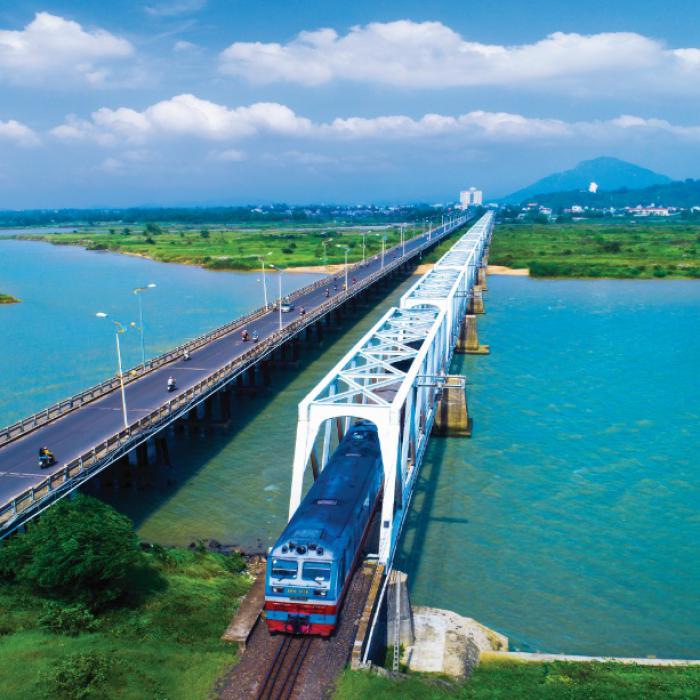
Upgrading of weak bridges and reinforcement of abutment on Hanoi – HCM city line
- Scope of works: rehabilitating and upgrading 111 bridges, constructing and reinforcing anti-collision piers for 6 bridges, repairing track bed and renewing 50 km of bridge–approaching section.
- Total investment: » 1,800 billions VND
Reinforcement of weak tunnels in combination of constructing new station and upgrading upper structure on Vinh – Nha Trang section
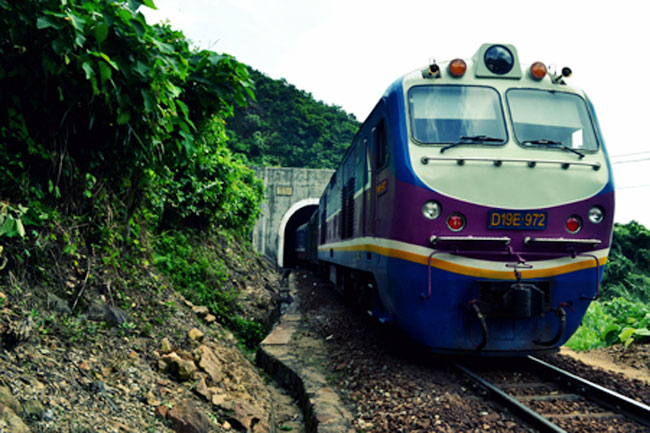
- Scope of works: rehabilitating 11 tunnels to ensure safety and increase train operation speed, lengthening platforms for 7 stations, constructing 3 new stations and halts between adjacent stations with the length of 17km, repairing track bed and renew 112.6 km of track, constructing 13 km of fences and feeder roads to abolish illegal level crossings.
- Total investment: 1,800 billions VND
VNR Online Ticketing System
Online Ticketing (Web)
Online Ticketing (Mobile)